Signed in as:
filler@godaddy.com

Born one hundred-fifty-two years ago in Danbury, Connecticut, Charles Ives was a free-thinker who wrote music that was decades ahead of its time. He was America’s first truly original composer, with much of his musical ideas originating from his bandmaster father, a musical jack of all trades who organized virtually every musical endeavor in the town of Danbury. The senior Ives was known for his various musical “experiments,” such as stationing bands at opposite ends of the town square and having them play different pieces in different keys as they marched toward and past each other. His father embraced the democratic idea that anyone could make music, and his son grew up believing that music was for everyone and that no sounds were “off limits.”
In 1891, at the age of 17, Ives composed a large-scale work for organ, the Variations on America, which he performed in local churches while still a teen. The piece is a witty and somewhat irreverent set of five variations and two interludes on the popular tune “My Country ‘Tis of Thee,” which at the time was considered the de facto national anthem of the United States. Although an early work, the writing is both creative and skillful - a precocious work showing that at 17, Charles Ives was a composer far ahead of his time.
The Variations was not published until 1948, after the organist E. Power Biggs discovered it, and in 1962, the composer William Schuman transcribed the work for orchestra. Ives’ biographer Jan Swafford notes that while it might be tempting to hear Variations on America as a satire, it is probable that Ives meant the work as a sincere exercise in variations for organ. Ives was not deaf to Variationscomic potential, however, and later noted that his father “didn’t let me do it much, as it made the boys laugh in church.”
Over his 80 years, Charles Ives produced some of the most original, forward thinking, and thoroughly American music the world had ever heard. He was obsessed with all the music around him, and it’s not unusual to find fragments of church hymns, circus marches, popular songs and ditties woven into one of his pieces. Much of the music world is still trying to figure out Ives’ music, which doesn’t fit any traditional mold, and to many his music sounds as though it was written “the wrong way.” However, his greatness did not go unrecognized, and he is best summed up in the words of Arnold Schoenberg, whose music was known world-wide at the time. “There is a great man living in this country – a composer. He has solved the problem of how to preserve one’s self-esteem and to learn. He responds to negligence by contempt. He is not forced to accept praise or blame. His name is Ives.”
Undeterred by years of composing in obscurity and having his music rejected because it was incomprehensible to many listeners with “cissy ears” (his term), Ives would go on to write over 700 works in various genres. He was finally awarded the Pulitzer Prize in Music in 1947 for his Third Symphony, and in 1951, Leonard Bernstein and the New York Philharmonic gave the world premiere of his First Symphony. Broader recognition had just begun when Ives died in 1954.

The most renowned German composer of the late 19th and early 20th centuries, Richard Strauss was a musical prodigy who grew up in a large musical family and began composing at the age of six. His father, Franz Strauss, a leading horn player in Germany at the time, played a crucial role in shaping Richard’s early musical career. In addition to choosing his teachers in piano, violin, and composition, Franz made instrumental music-making central to the Strauss home, and taught his son the music of Beethoven, Haydn, Mozart, and Schubert.
Franz Strauss also showcased his son's compositions in performances with an amateur orchestra he conducted from 1875 to 1896 and many of Strauss’ early symphonic compositions were written for this ensemble. His father undoubtedly influenced his son's developing musical taste as well, not least in Strauss's abiding love for the horn. His Horn Concerto No. 1 is representative of this period and is a staple of the modern horn repertoire.
Strauss lived through a remarkable period in German history, one that encompassed the rise and fall of the German empire, two world wars, Hitler and the challenges of national socialism in Germany. The year of his death was the same year that Germany was split into East and West, and the fighting war gave way to the Cold War and the scourge of communism. Born at a time when homes were illuminated by oil lamps, his death coincided with a world defined by nuclear power. Throughout this tumultuous period, however, Strauss maintained a distinguished career as composer and conductor that spanned almost eight decades, during which he explored nearly every musical genre, ultimately gaining international recognition for his tone poems from the late 19th century and his operas from the early 20th century.
Strauss wrote his Horn Concerto in E flat at age 18 while studying philosophy at the University of Munich. Considered one of his first important compositions, the title “Waldhornkonzert” indicates that the solo horn part was to be played on the natural valveless horn. While it is possible to play the concerto on the natural horn (Waldhorn), in practice, it’s nearly impossible to give a convincing performance. Even Franz the father found it tiring, and never performed the work in public. All modern performances and recordings are played on the valved F double horn, which was developed at the end of the 19th century.
The work is in three movements and is a brilliant showcase of the horn as a solo instrument. Typical of Strauss’s music – Romantic in style, with themes that are catchy, memorable and distinctive - the concerto offers us hints of what is to come, foreshadowing the great “Horn moments” in Till Eulenspiegel’s Merry Pranks, Don Juan, Ein Heldenleben, and Don Quixote.
Strauss’ Legacy
With his characteristic self-deprecation, Strauss himself declared in 1947: "I may not be a first-rate composer, but I am a first-class second-rate composer." The Canadian pianist Glenn Gould, however, described Strauss in 1962 as "the greatest musical figure who has lived in this century.” Strauss has always been popular with audiences in the concert hall and continues to be so. He has consistently been in the top 10 composers most performed by symphony orchestras in the US and Canada over the period 2002–2010. He is also in the top 5 of 20th-century composers in terms of the number of currently available recordings of his works.

Primarily known as a cellist, Spanish-American Andrea Casarrubios is also a composer who has become one of the most sought-after composers in the string world. As a guest cello soloist, her engagements include the Charlotte Symphony’s world premiere of her Concerto for Cello and Orchestra, Mirage, led by conductor Christopher James Lees, as well as concerts at the Brussels Cello Festival, Festival Internacional de Violoncello Leonin Mexico, and the George Enescu Festival in Romania.
A composition student of John Corigliano, Casarrubio’s works have been programmed by numerous organizations, including Carnegie Hall, the Chicago Symphony, Indianapolis Symphony, and the Charlotte Symphony, and have been broadcast on National Public Radio as well as national radio stations in Argentina, Brazil, France, Sweden, Australia, and Spain. Herencia, a recent work for string orchestra, is a Sphinx Organization commission for their 2023-24 tour "Generations." It reflects on how each artist brings a unique and complex history to every performance - "a bond of humanity through music" (The Boston Musical Intelligencer) in which the audience is encouraged to observe their own story and how it has led them to this concert.

Aaron Copland is generally considered one of America’s greatest composers, credited with what has come to be known as an “American Sound.” The son of Jewish immigrants, he lived most of his life in New York City, but in his music, one can hear elements of jazz, ethnic, western, folk, and European continental. His wide-ranging intellect, however, synthesized all of these disparate musical styles into a style all his own that speaks with a clear and unified expression.
One of Copland’s most popular pieces, Lincoln Portrait, was commissioned during the early years of World War II by conductor Andre Kostelanetz for a program of new works by American composers. Scored for orchestra and narration, Copland chose excerpts from Lincoln’s own words for the narration.
Lincoln Portrait is divided roughly into three sections: The opening section suggests a sense of melancholy and gentleness and simplicity of spirit that characterized Lincoln’s personality; the livelier middle section relates to the time in which Lincoln lived, and like much of Copland’s populist and patriotic music, there are quotes from traditional popular tunes - Springfield Mountain and Camptown Races; the final section serves to frame the words of Lincoln himself, and includes excerpts from the Gettysburg Address, the Lincoln-Douglas debates, and one of the State of the Union speeches.
The work was an inspiration for the difficult times of the war, but about 1950 both Copland’s music and his popular place in society took a downward turn. His earlier association with socialist causes, such as his support of the American Communist Party in the election of 1936, made him a target of the “red scare” and Senator Joseph McCarthy. Consequently, the Republican Party cancelled a performance of Lincoln Portrait that was planned for Dwight Eisenhower’s inauguration.
The McCarthy probes did not seriously affect Copland’s career and international artistic reputation, but shortly after his encounter with the United States Congress, he began resigning from participation in leftist groups.
The following is the text Copland wrote for the Narrator in Lincoln Portrait.
“Fellow citizens, we cannot escape history”
That is what he said,
That is what Abraham Lincoln said:
“Fellow citizens, we cannot escape history. We of this Congress and this administration will be remembered in spite of ourselves. No personal significance or insignificance can spare one or another of us. The fiery trial through which we pass will light us down, in honor or dishonor, to the latest generation. We—even we here—hold the power and bear the responsibility”
He was born in Kentucky, raised in Indiana, and lived in Illinois.
And this is what he said:
This is what Abe Lincoln said:
He said:
“The dogmas of the quiet past are inadequate to the stormy present. The occasion is piled high with difficulty, and we must rise with the occasion. As our case is new, so we must think anew and act anew. We must disenthrall ourselves, and then we shall save our country.”
When standing erect he was six feet four inches tall.
And this is what he said:
He said:
“It is the eternal struggle between two principles—right and wrong—throughout the world. . .. It is the same spirit that says, ‘You toil and work and earn bread—and I’ll eat it.’ No matter in what shape it comes, whether from the mouth of a king who seeks to bestride the people of his own nation and live by the fruit of their labor, or from one race of men as an apology for enslaving another race, it is the same tyrannical principle!”
Lincoln was a quiet man.
Abe Lincoln was a quiet and a melancholy man.
But when he spoke of democracy,
This is what he said:
He said:
“As I would not be a slave, so I would not be a master. This expresses my idea of democracy. Whatever differs from this, to the extent of the difference, is not democracy.”
Abraham Lincoln, sixteenth President of these United States, is everlasting in the memory of his countrymen.
For on the battleground at Gettysburg, this is what he said:
He said:
“. . . that from these honored dead we take increased devotion to that cause for which they gave the last full measure of devotion: that we here highly resolve that these dead shall not have died in vain; that this nation, under God, shall have a new birth of freedom; and that government of the people, by the people, and for the people shall not perish from the earth.”
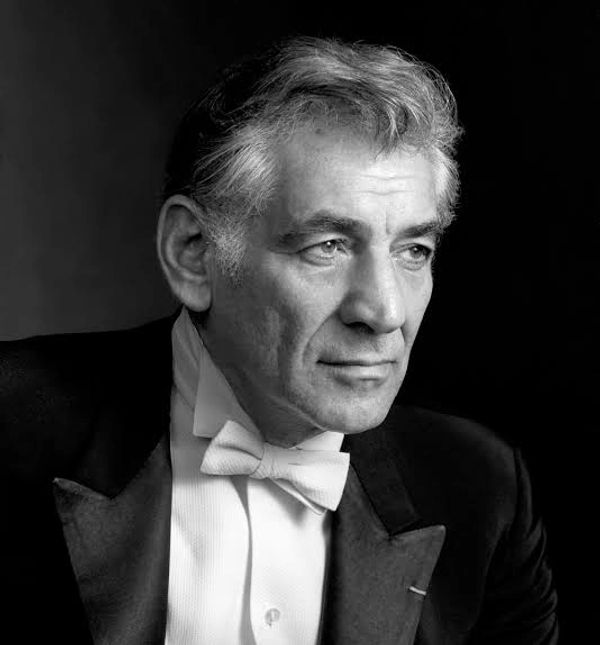
The name Leonard Bernstein is familiar to concert-goers everywhere. As a conductor, composer, pianist, music educator, and humanitarian, Bernstein was one of the most important musicians of his time. As conductor of the New York Philharmonic for several years, he had the distinction of being the first American-born musician to lead a major American symphony orchestra.
Bernstein firmly believed in the value of music education as a means of building new audiences and keeping symphonic music relevant to the people. He was the first conductor to bring music education to a mass audience with the New York Philharmonic’s Young People’s Concerts, which reached audiences all across the nation through the miracle of television. With his masterful ability to communicate with audiences, Bernstein made the elements of classical music come alive and accessible to everyone, and several generations of young musicians found inspiration through his educational efforts. Leonard Bernstein was the Renaissance Man of his day and time in history – versatile, prodigiously talented, and immensely successful in whatever he chose to do.
As a composer, Bernstein wrote in many genres, but his best-known work is the 1957 Broadway musical West Side Story, which continues to be performed worldwide. Regarded as one of the greatest musicals of all time, the story is an American musical romantic drama inspired by Shakespeare’s play Romeo and Juliet. This evening’s performance of the Overture to West Side Story includes several favorite songs from the show, including Tonight, Maria, One Hand, One Heart, and others.
During his lifetime, Leonard Bernstein was honored with numerous awards, including seven Emmys, two Tony awards, sixteen Grammys, and a Kennedy Center Honors award. It can be said, without exaggeration, that Leonard Bernstein was one of the truly great musicians in all of American music history.